
My wife, Courtney Hood, coined a word I have not stopped using since.
Snoopification. Noun. The practice of putting a mascot or a brand on every available surface, with no shame and no particular reason. To snoopify is to decide that a character or a logo is no longer a character or a logo, it is a pattern, and a pattern can go on anything.
It works the same either way. A face and a wordmark are the same kind of asset once someone decides it can be printed on a lunchbox. Most of this post is about mascots, because mascots make the damage visible, but there is a section further down on what happens when it is a logo instead, and the pattern is identical.
It is named after Snoopy, which is either a compliment or an accusation depending on where you stand. Snoopy is on more objects than almost any drawn thing in history. He is also, somehow, completely fine. That contradiction is the whole reason the word is useful.
Does the word already exist?
I checked before writing anything, because coining a term that is already sitting in a dictionary is a bad look.
The nearest collisions:
- "Snoopified" is a 2005 Snoop Dogg greatest hits album on Priority Records. Different Snoop, no relation.
- "Snoopified" also has an Urban Dictionary entry meaning something that has had a monitoring service attached to it. Sysadmin slang, not branding.
- "Snoop filter" is a cache coherency term in multiprocessor design. Very much not this.
Searching the branding sense of snoopification, snoopyfication, and snoopyification returned nothing. Zero marketing articles, zero trade press, zero blog posts. The word is free.
Its neighbours already exist and mean other things, which is worth being clear about:
- Disneyfication is about sanitising and homogenising a place or a story until it is safe and smooth. That is about tone.
- McDonaldization is George Ritzer's term for efficiency, calculability, and control eating a culture. That is about process.
- Enshittification is Cory Doctorow's word for platforms decaying as incentives shift. That is about decay.
- Brand dilution is the industry term, and it is the dullest possible phrasing of a thing you can watch happen in a gift shop.
Snoopification is none of those. It is about surface area. How many objects is this face on, and did anyone stop to ask why.
Why name it after the one that got away with it
Because Snoopy is the extreme case, and the extreme case is what a word should be named after.
Here is a beagle from a newspaper strip about childhood disappointment. Look where he ended up.
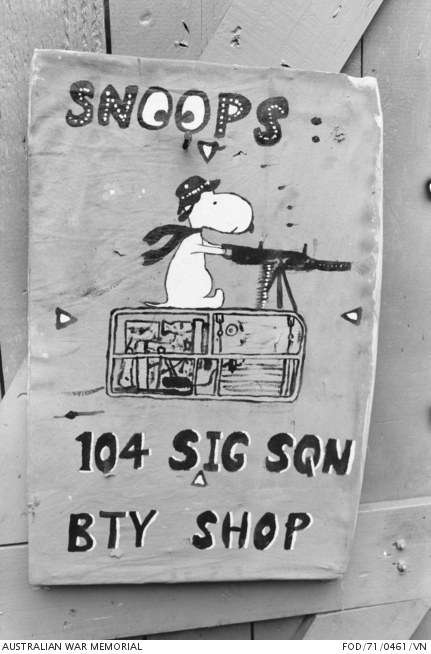
Snoopy as the mascot for 104 Field Battery, Royal Australian Artillery, photographed 2 September 1971. Photo: John Alfred Ford, Australian War Memorial collection, via Wikimedia Commons, CC0.

A gun battery in an active war painted a comic strip dog on its sign. Nobody involved thought this was strange.
Then there is NASA. After the Apollo 1 fire in 1967, NASA leaned hard on its Manned Flight Awareness safety programme and needed a mascot. It picked Snoopy. The Silver Snoopy award is now handed out personally by astronauts to the engineers and contractors who kept people alive, and it is one of the most coveted things you can be given in American spaceflight.
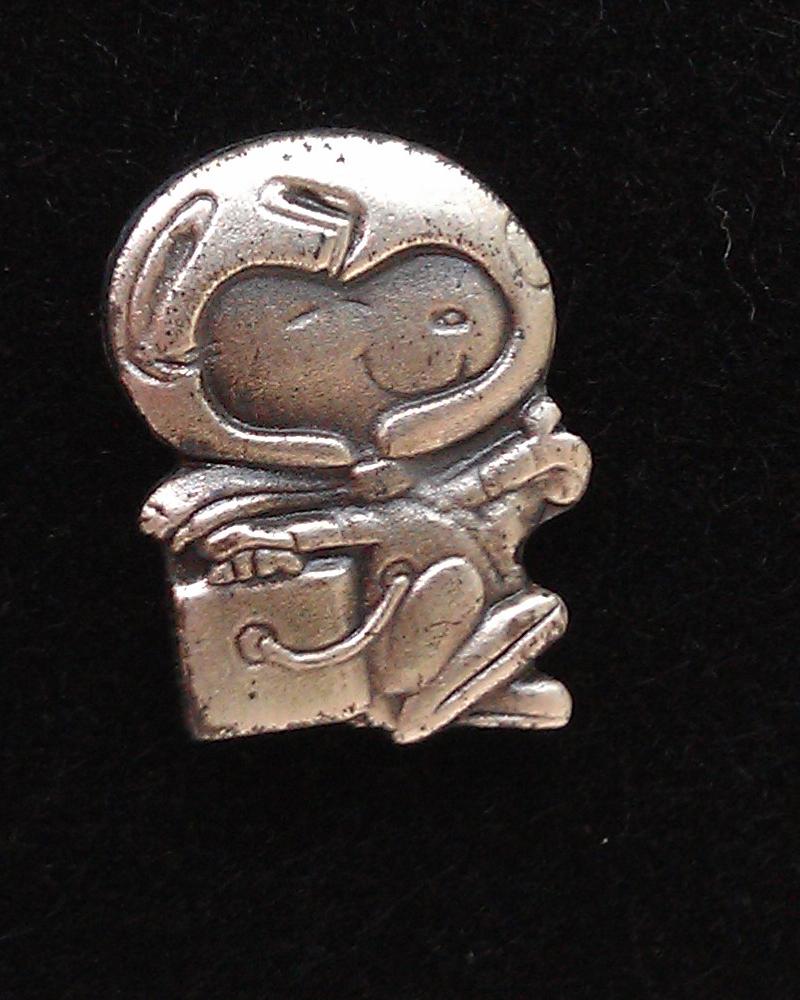
A Silver Snoopy lapel pin flown aboard STS-116. Photo: Wikimedia Commons user Nitrorat, CC BY-SA 3.0.
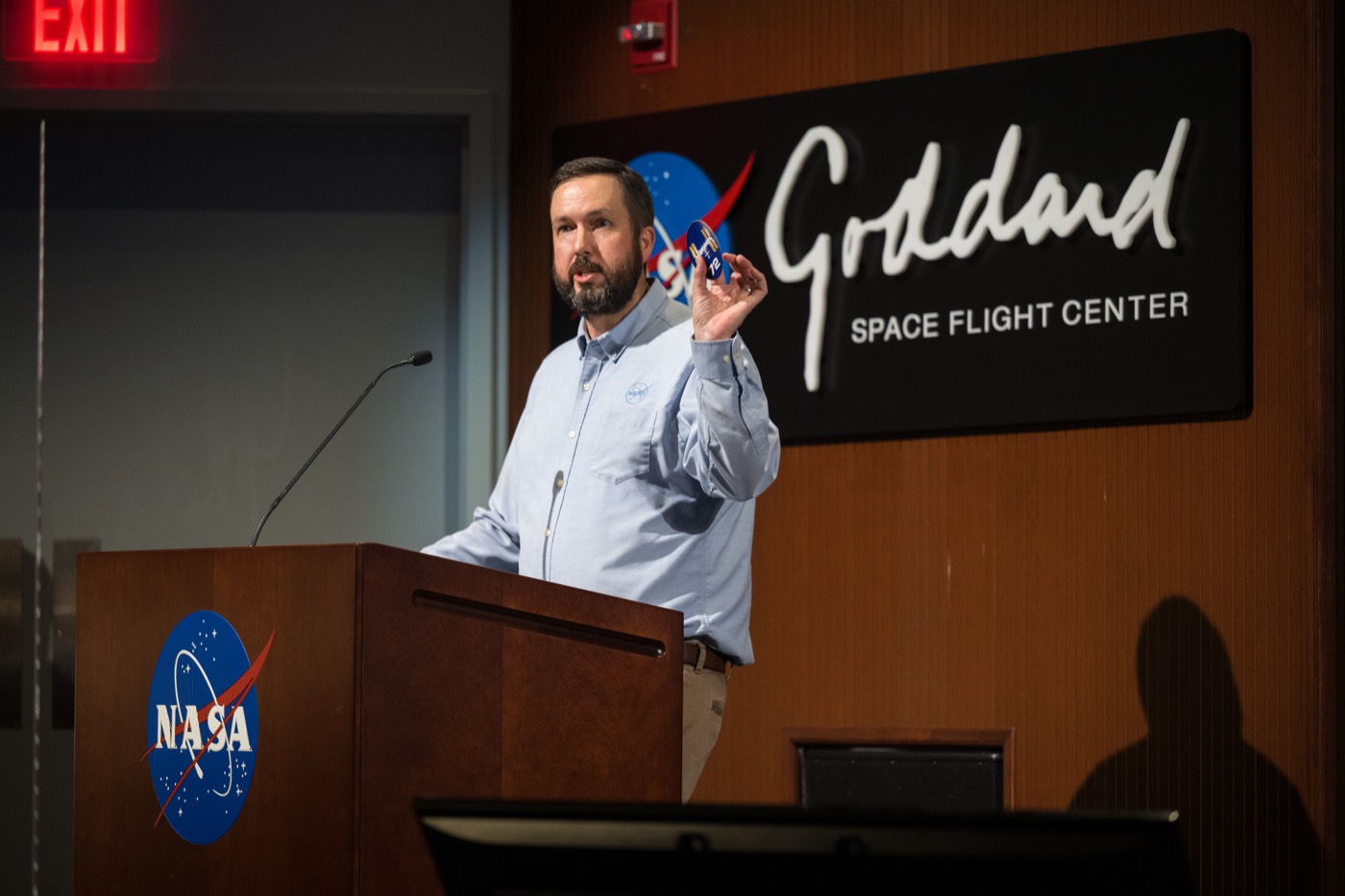
A Silver Snoopy award event at NASA Headquarters, 17 September 2025. Photo: NASA / Aubrey Gemignani, public domain, via Wikimedia Commons.
.jpg)
In May 1969, Apollo 10 named its lunar module Snoopy and its command module Charlie Brown, because the plan was to fly down and snoop around the Apollo 11 landing site. That is the United States government naming spacecraft after a cartoon dog and a sad boy, on the record, in the mission log.
It kept going. A whole shop in Yokohama:
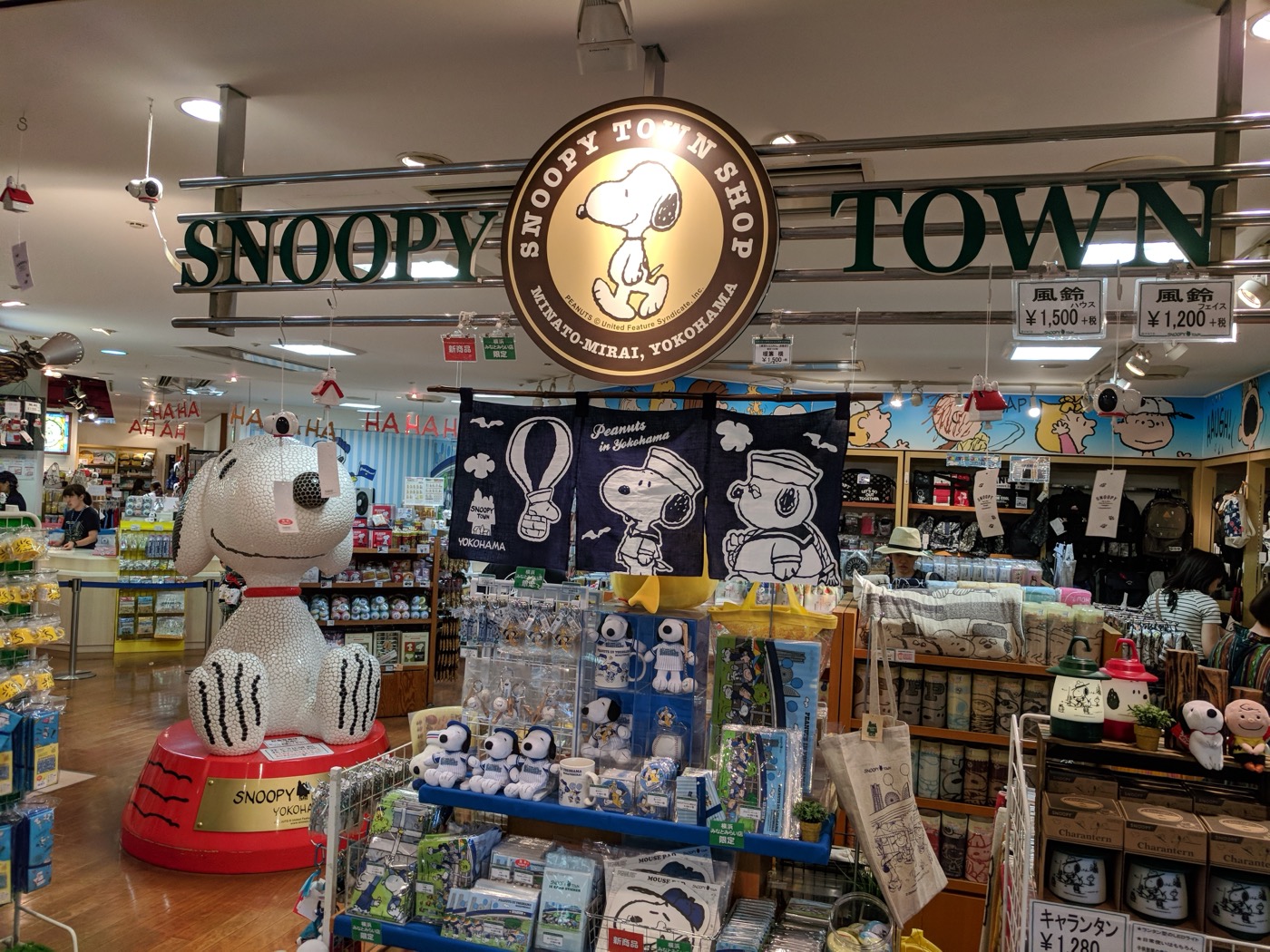
Snoopy Town, Yokohama. Photo: todd.vision, CC BY 2.0, via Wikimedia Commons.

A dedicated gallery and gift shop in Santa Rosa, California:
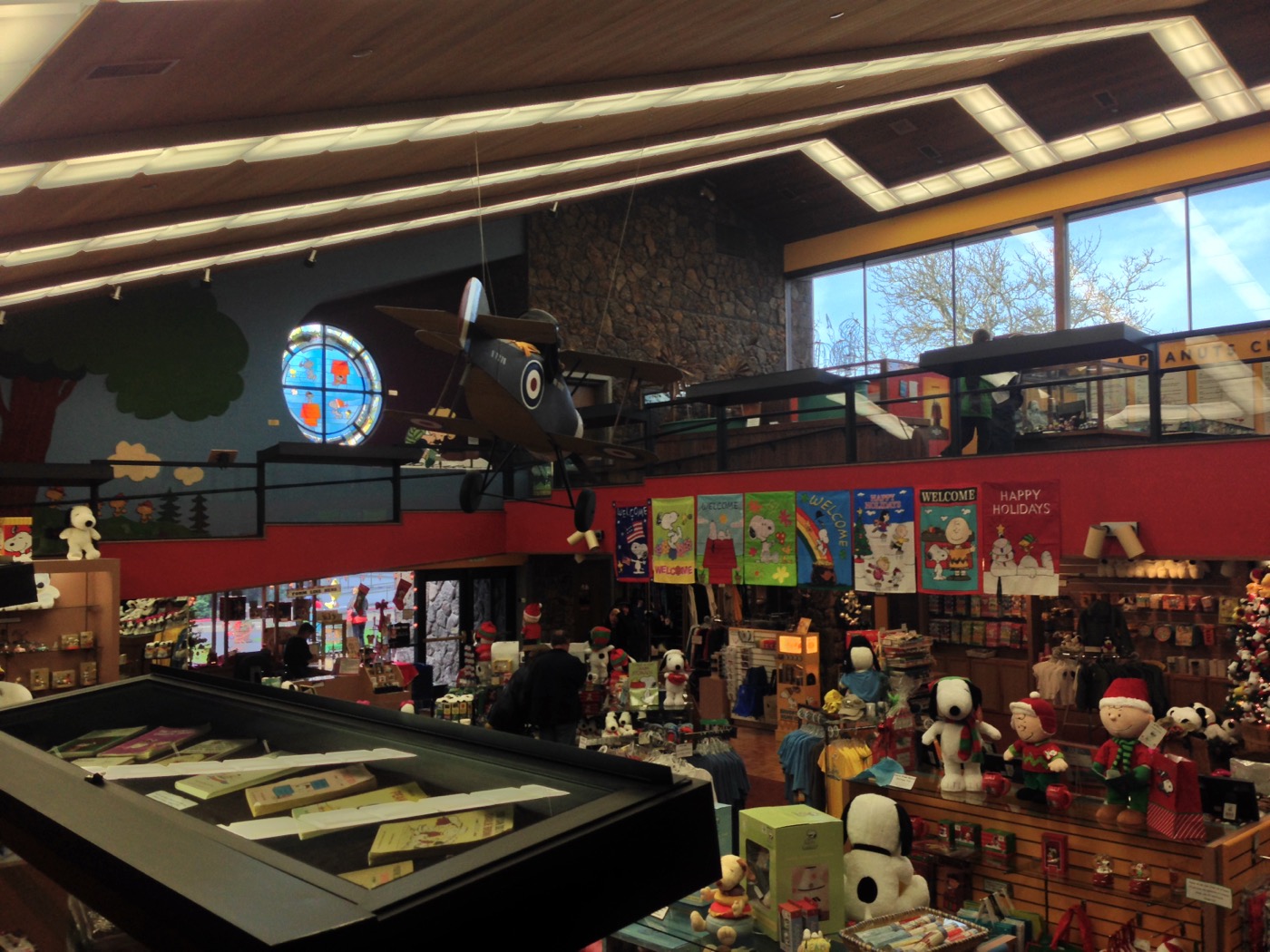
Snoopy's Gallery and Gift Shop, Santa Rosa. Photo: Wikimedia Commons user Myotus, CC BY-SA 4.0.
A statue in a public park in Livorno, Italy, for no reason anyone has ever explained to me:
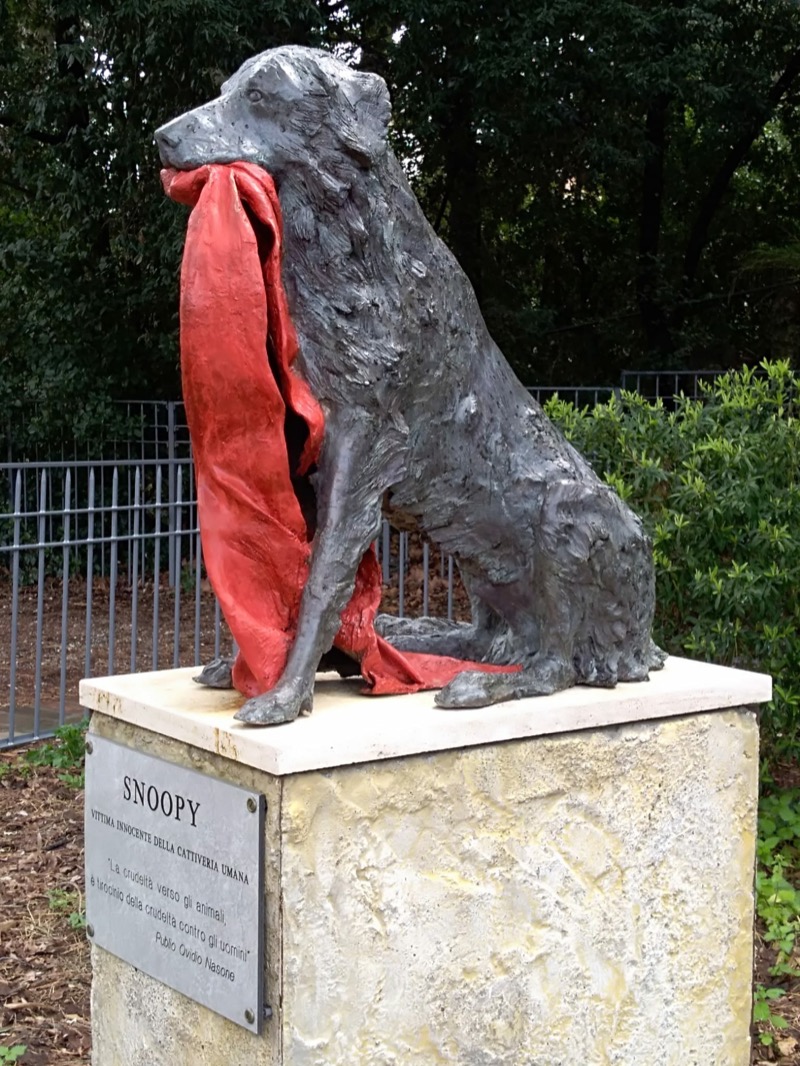
Snoopy in Villa Fabbricotti park, Livorno. Photo: Wikimedia Commons user 5e5Alex, CC BY-SA 4.0.
And then the luxury end, which is where snoopification stops being funny and starts being a business plan. Omega sells a Speedmaster "Silver Snoopy Award" watch, a real chronograph named after the safety pin. Gucci put him on knitwear in 2016. In March 2025, for the strip's 75th anniversary, an exhibition in the Marais called "Snoopy in Style" showed 75 Snoopy and Belle dolls dressed by Valentino, Lacoste, Simone Rocha, Paul Smith, Sacai and others.
War, space, Yokohama, an Italian park, a Swiss chronograph, the Marais. Peanuts merchandise sells in more than 100 countries.
Here is the part that should end the argument. In December 2025, Sony agreed to buy WildBrain's 41% stake in Peanuts for C$630 million, about $457 million. The deal closed on 2 March 2026. Sony now holds 80%, the Schulz family holds 20%. Seventy-five years after a strip about a boy who cannot kick a football, somebody wrote a nine figure cheque for a minority slice of it.
Snoopy has been snoopified harder than anything alive and he is worth more than ever.
So what is the actual mechanism
This is where the word earns its keep, because snoopification is not automatically bad. It is a bet.
You are spending a character's meaning to buy reach. Every new object with that face on it makes the character more visible and slightly less specific. Visible is easy to measure. Specific is not.
You survive the bet if the character keeps generating new meaning faster than the merchandise spends it. You lose the bet if the merchandise is the only place the meaning ever lived.
Snoopy had a generator. Charles Schulz wrote, lettered and drew all 17,897 Peanuts strips himself, for fifty years, with no assistants on the newspaper strip. He died on 12 February 2000. The last original strip ran the next morning. Fifty years of a dog who fails, sulks, dances, and privately believes he is a First World War flying ace fighting the Red Baron from the roof of his kennel.
That is a deep enough well that you can draw a plush toy out of it every day for decades and not hit the bottom. The mug is not where Snoopy lives. The mug is a souvenir of somewhere else.
Garfield is the control group
Garfield got the same treatment. He did not get the same result, and the reason is documented by the man who made him.
Jim Davis has never been coy about this. In a Washington Post interview in December 1982, he described Garfield as "a conscious effort to come up with a good, marketable character." He noticed dogs were everywhere in the funnies and nobody was serving the country's cat owners. That is not a knock. It is a genuinely sharp read of a market, and it worked better than almost any comics decision ever made.
The numbers are ridiculous:
| What | Figure |
|---|---|
| Merchandise sold by early 1981, under three years in | over $15 million |
| Newspapers carrying the strip, 2013 | roughly 2,580, a Guinness World Record |
| Annual merchandise sales, 2004 | $750 million to $1 billion, across 111 countries |
| Sold Paws, Inc. to Viacom (now Paramount) | 6 August 2019 |
Snoopification, executed perfectly. And Garfield is not a failure today either. The Garfield Movie took roughly $91 million domestically and over $245 million worldwide in 2024 on a budget around $60 million, even while critics parked it at 36% (audiences were far kinder at 79%, checked 2 August 2026, both numbers drift).
But go and look at the strip credits. Since the late 1990s, Davis has mostly written and roughed, with long-time assistants Brett Koth and Gary Barker doing most of the drawing, while Davis supervised production and merchandising. The generator was throttled at exactly the moment the merchandise ran hottest.
And there is one image that says it better than any figure in that table. Since a storm in 1983, bright orange plastic Garfield telephones have been washing up on the Iroise coast of Brittany from a lost shipping container. Locals collected the pieces for thirty five years before the container was finally traced to a sea cave in 2019. It is still under the rocks. The phones are still coming ashore.
I cannot show you a photo of that, because every good one is a wire service image I do not have the rights to reproduce. Go and look at the CBS coverage, it is worth the click. A mascot, manufactured in enough volume to lose a container of it and not really notice, turning up as beach litter for four decades. That is snoopification's landfill.
The test, in one question
Take the merchandise away. What is left?
For Snoopy, an entire body of work that people still read, still quote, and still cry at. For Garfield, there is real work there too, and the strip is better than its reputation, but the creator himself spent forty years pointing at the products.
Which brings me to the quote that made me want to write this in the first place. Asked in 2018, for Garfield's 40th anniversary, how he wanted the cat remembered, Davis said:
"I certainly want him to be known as a comic strip, because that's where he really entertains. That's where he struts his stuff. That's his sweet spot."
The man who designed a cat to sell things, and then sold roughly a billion dollars of things a year, would like the cat to be known for the drawing.
The same thing happens to logos
Swap the drawn character for a wordmark and nothing about the mechanism changes. The brand side has its own Snoopy and its own Garfield.
Supreme is the brand-side Snoopy. For autumn/winter 2016 it sold a clay brick with the box logo stamped into it, around $30, and it sold out. It has also put that logo on a crowbar, a fire extinguisher and a long tail of things nobody needs. In February 2020 it put the logo on Oreos, three cookies for about $8, and people flipped packets on eBay for hundreds.
That is snoopification with the shame dial set to zero, and it worked, for exactly the reason Snoopy works. Supreme's meaning is not manufactured in the object. It is manufactured in the scarcity, the Thursday drop, the queue, the culture the brand came out of. The brick is a receipt for belonging to something. You can stamp that logo on a brick precisely because the brick was never carrying the meaning.
Harley-Davidson is the brand-side Garfield. In the 1990s Harley licensed its name onto aftershave, perfume, wine coolers, and, in 1996, a children's cake decorating kit. Harley's meaning is generated by an actual motorcycle: the noise, the weight, the ride. Perfume cannot generate any of that. Every one of those products was a pure withdrawal from a bank account nothing was being paid into.
Riders noticed, and here is the detail that made me sure this word needed to exist. Harley loyalists accused the company of "Disneyfying" the brand. That is not what Disneyfication means. They reached for the nearest available word because the right one did not exist. They were not describing sanitisation. They were describing surface area.
So the test travels. If your logo is on a thing, ask what is refilling the well. Supreme has an answer. Harley's cake kit did not.
Where my own theory gets shaky
If I am going to argue this, I should name the case that argues back.
Hello Kitty. Sanrio has put her on tens of thousands of product lines, and she has almost no interiority at all. She famously has no mouth. There is no fifty year body of work about her private disappointments. By my theory she should have burned out decades ago, and she did not. The honest answer is that her blankness is the point, she is a surface people project onto rather than a character they read, and the projection refills the well the way Schulz's strips did. I am not fully satisfied by that answer, and if you want to break my argument, that is where to push.
The modern death stunt. Two of the loudest mascot campaigns of the last six years were mascots dying. Planters killed Mr. Peanut before the 2020 Super Bowl and returned him as Baby Nut. Duolingo killed Duo the owl in February 2025 and brought him back two weeks later, having pulled about 1.7 billion impressions out of the bit. Both of these are snoopification looking for a fresh hit. When the surface area is maxed out, you start doing things to the character because you have run out of places to put it.
How to spot it in your own work
If you make things, this is the useful part. The tells are consistent:
- It appears where it cannot help. Error states, legal pages, invoices, a 404. If your mascot is apologising for a payment failure, or your logo is embossed on a thing that has no use for a logo, ask who that is for. I am not clean here. Our own 404 page is a fighting game starring my two cats, on a surface that did not ask for one.
- No one can say what it wants. If your team can list twelve products it is on and zero things it believes, you have a pattern, not a character and not a brand.
- New meaning has stopped being made. Merchandising is a withdrawal. Something has to be a deposit. Strips, episodes, stories, jokes, a genuinely better motorcycle, anything that adds rather than reprints.
- It is doing the work the product should do. The Snoopy on the front of the shop is not why the shop is good. The box logo is not why the brick is a brick.
None of these mean stop. Snoopy failed all four of these tests and got a couture show in Paris. They just mean know what you are spending.
The thought I keep landing on
Snoopification is trivially easy to start and effectively impossible to take back. There is no meeting where a company decides its character is now on fewer things. The surface area only ever grows, one reasonable decision at a time, until the face is everywhere and means nothing, or until it turns out somebody spent fifty years quietly filling the well and it means everything.
The difference is not the merchandise. It is whether anyone is still writing the dog.
Credits and sources
All photographs are used under the licences listed and are credited to their photographers. The characters depicted remain the property of their respective owners: Peanuts characters are owned by Peanuts Worldwide LLC, Garfield by Paramount.
Photographs
- Snoopy as mascot, 104 Field Battery, Royal Australian Artillery, 2 September 1971. John Alfred Ford, Australian War Memorial collection. Wikimedia Commons, CC0.
- Silver Snoopy award tie tack flown on STS-116. Nitrorat. Wikimedia Commons, CC BY-SA 3.0.
- Silver Snoopy award event, NASA Headquarters, 17 September 2025. NASA / Aubrey Gemignani. Wikimedia Commons, public domain.
- Snoopy Town, Yokohama. todd.vision. Wikimedia Commons, CC BY 2.0.
- Snoopy's Gallery and Gift Shop, Santa Rosa. Myotus. Wikimedia Commons, CC BY-SA 4.0.
- Snoopy statue, Villa Fabbricotti, Livorno. 5e5Alex. Wikimedia Commons, CC BY-SA 4.0.


Sources
- WildBrain: sale of its 41% stake in Peanuts to Sony and closing announcement, 2 March 2026
- NASA: the Silver Snoopy award and Apollo 10
- WWD on the "Snoopy in Style" 75th anniversary exhibition and designboom's coverage
- Smithsonian on Schulz and the 17,897 strips
- Wikipedia's Garfield article, which sources the 1982 Washington Post quote, the syndication record and the merchandise figures
- Variety on the 2019 Paws, Inc. acquisition
- Screen Rant on Jim Davis's 2018 Vice interview
- TIME and CBS News on the Garfield phones of Brittany
- CNN on Mr. Peanut and Baby Nut, Fast Company and Meltwater on Duolingo's dead owl
- Highsnobiety on the Supreme brick, Complex on Supreme's strangest accessories and Hypebeast on the Supreme Oreo
- The Museum of Failure on Harley-Davidson perfume and Brand Failures on the wider Harley licensing run
The word is Courtney's. I am just the one who wrote it down.